



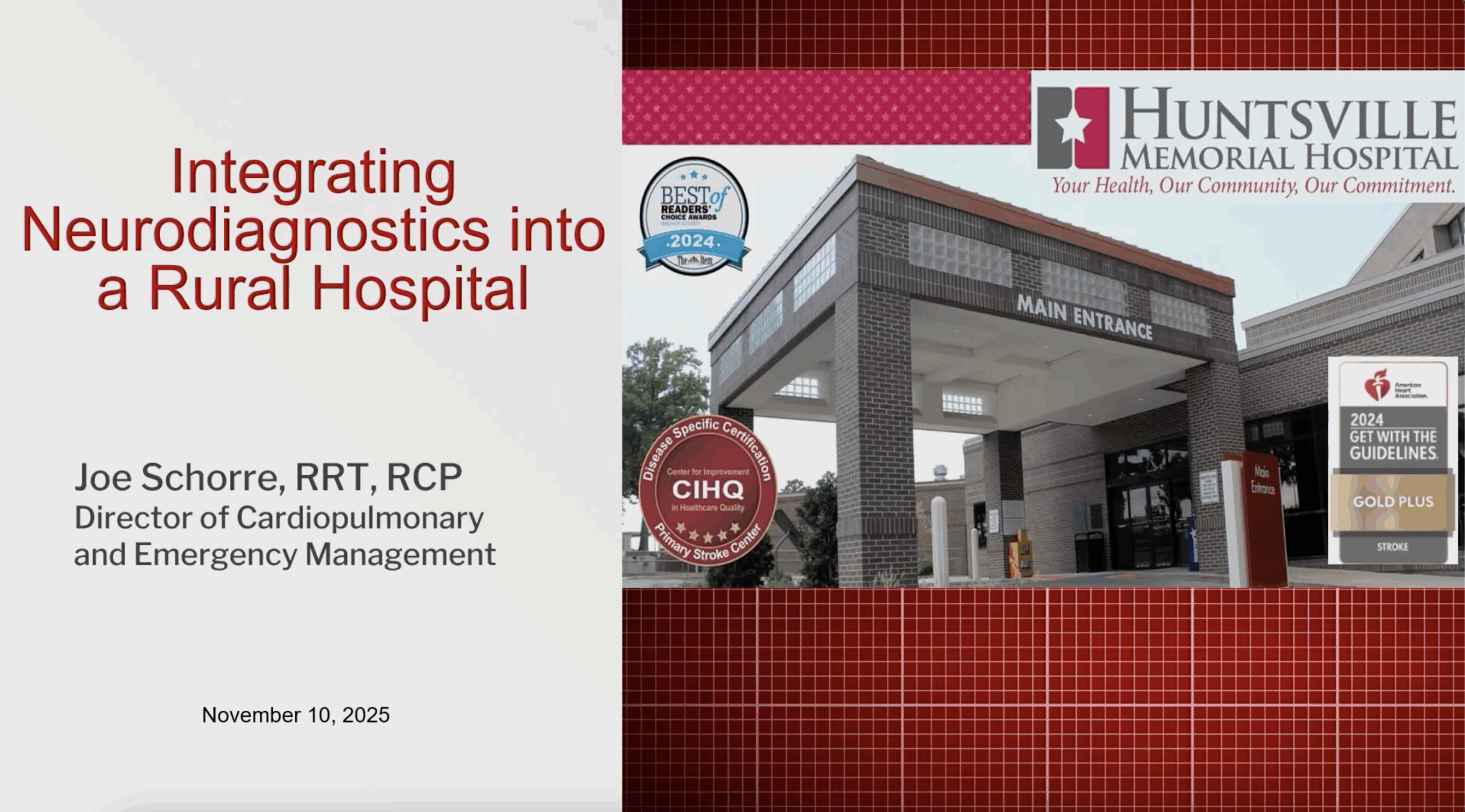
In this presentation from the American Heart Association’s Scientific Sessions, Joe Daniel Schorre, Director of Cardiopulmonary and Emergency Management at Huntsville Memorial Hospital in East Texas, shares how his team solved a major care gap: the complete absence of EEG services in their rural community.
With no neurologists on staff, no EEG techs, and no ability to perform EEG onsite, the hospital had been forced to transfer nearly half of its neuro-related patients – about 10 patients each month – solely because EEG was unavailable. Joe explains how implementing the Zeto rapid EEG system enabled faster diagnosis, reduced transfers, retained critical hospital revenue, and kept patients closer to home and family support.
For a deeper look at Huntsville Memorial Hospital’s journey, you can also read the full case study with Joe Schorre here: View detailed case study → LINK.
Below is the transcript of his talk.
Huntsville Memorial Hospital, a rural facility in East Texas about 60 miles north of major academic medical centers, was founded in 1927. It is a 123-bed acute care hospital serving a diverse population that includes families with limited incomes, a high local poverty rate, seven state prisons, and a large university community. The hospital’s mission is to care for the community with compassion, integrity, and excellence.
A 24-month review of emergency transfers revealed a clear problem: the hospital was sending out every patient who required EEG services. These transfers often meant more than an hour of travel, delayed diagnosis and treatment, lost hospital revenue, and significant financial and emotional burdens on families. The average out-of-pocket cost for a transfer was around $200, not including lost wages or the stress placed on patients and caregivers. For many in the community, this was simply unsustainable.
The team needed an EEG solution that fit into the existing workflow, required minimal capital investment, and didn’t rely on specialized EEG personnel. After evaluating available technologies, they selected the Zeto rapid EEG system, which integrates easily into the respiratory care workflow and allows remote epileptologists to review studies live when necessary and complete final interpretations afterward.
Within three months, the hospital moved from device selection to full implementation, going live on December 16, 2024. In the first six months, the program enabled the hospital to retain 44 admissions that otherwise would have been transferred. This kept patients close to home, preserved essential hospital revenue, and reduced the financial and emotional strain associated with transfers.
Keeping patients local improves continuity of care, supports faster diagnosis and treatment, and allows families to remain involved at the bedside. It also strengthens trust between Huntsville Memorial Hospital and the community it serves.
This program has been transformative for the facility and is something many rural hospitals may want to consider. It reduces unnecessary transfers, increases admissions that would otherwise be lost, and elevates the level of care delivered locally. Huntsville Memorial Hospital is proud to share the impact of this initiative and the role Zeto EEG has played in supporting rural healthcare.
Many small hospitals face similar challenges: no EEG services, no neurologists to interpret studies, and no EEG technicians. The hospital’s review showed that nearly half of its neuro-related transfers—about 10 patients per month—were due solely to the absence of EEG. Implementing rapid EEG directly addressed this gap and brought essential neurodiagnostic capabilities to the community.
Bring rapid EEG to your rural hospital
If your facility faces high transfer rates, limited access to neurologists, or challenges delivering neurodiagnostic services, Zeto can help you.
Learn more or schedule a demo → Contact Us