



Based on an educational webinar presented by Dr. Armin Jewell, Neurologist and Epileptologist from Allina Health in Minnesota, for the Neurocritical Care Society.

As point-of-care EEG (POC EEG) becomes increasingly integrated into emergency and critical care, clinicians are asking an important question: Where does this technology fit into modern neurologic practice?
During a recent Neurocritical Care Society webinar, Dr. Armin Jewell, neurologist and epileptologist in Minneapolis, Minnesota, provided an evidence-based overview of point-of-care EEG, comparing it with conventional EEG while reviewing its clinical applications, current limitations, and future potential. From rapid seizure detection to emerging uses in stroke, traumatic brain injury, delirium, and post-cardiac arrest care, the webinar emphasized both the opportunities and the appropriate clinical role of this evolving technology.
What Is a Point-of-Care EEG?
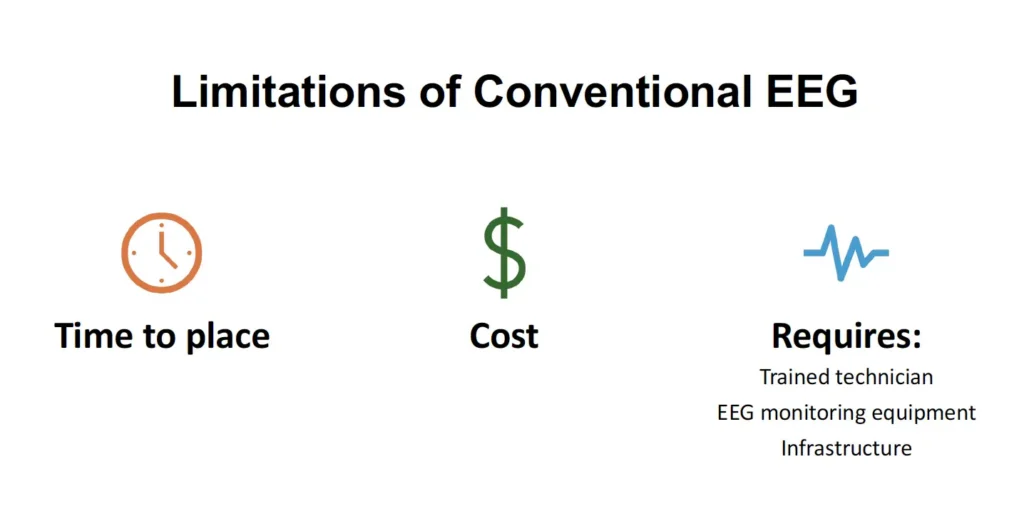
Point-of-care EEG (POC EEG) technology was developed to address the logistical, technical, and workflow limitations of conventional EEG in managing acute neurological conditions. While conventional EEG remains the gold standard for assessing brain activity, it requires a trained EEG technologist, specialized monitoring equipment, and hospital infrastructure – all of which can delay EEG acquisition when rapid clinical decisions are needed.
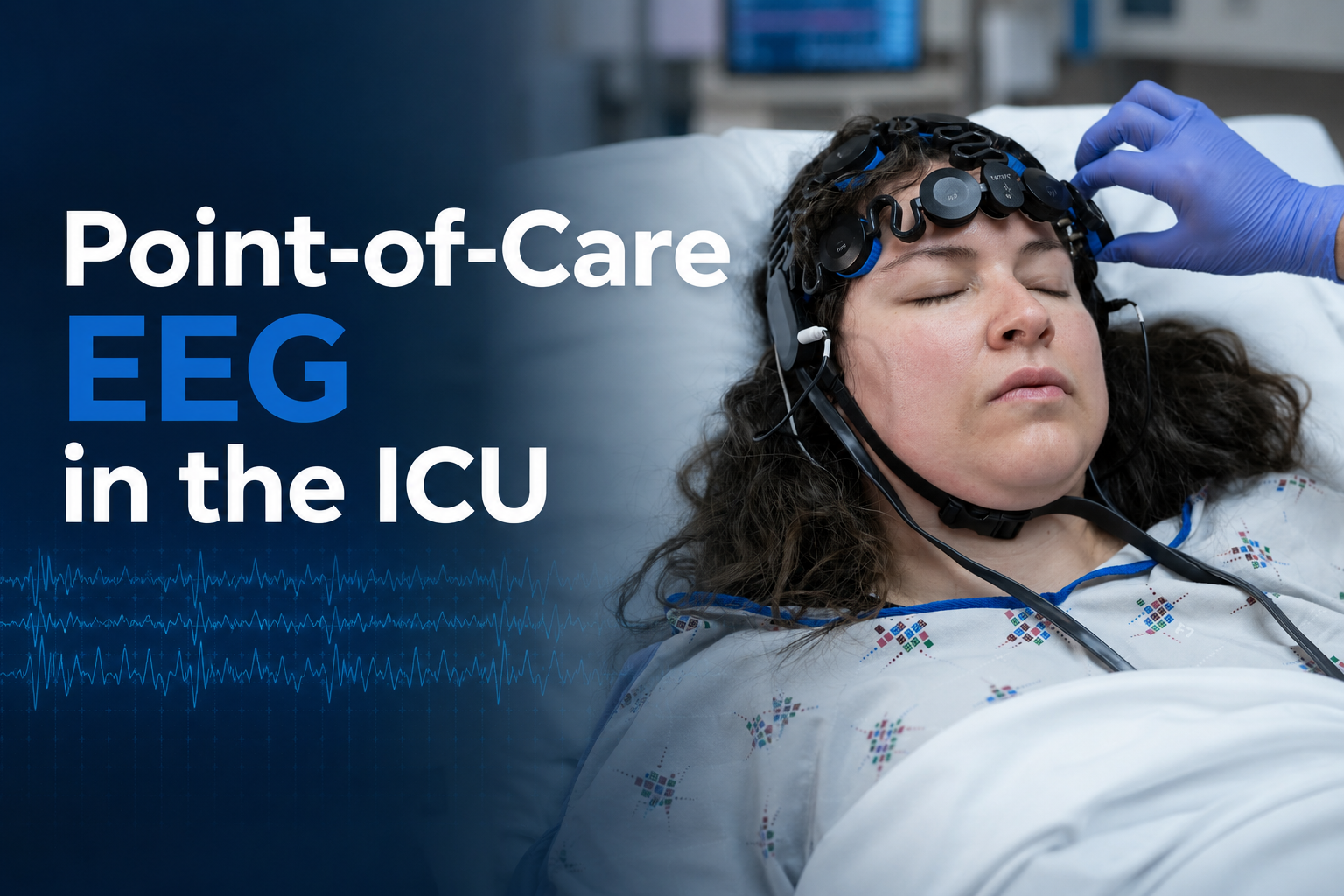
Introduced around 2018, point-of-care EEG systems typically use simplified and limited electrode arrays – usually disposable headbands or headsets designed for rapid bedside application – to capture clinically relevant EEG data within minutes. By simplifying deployment and eliminating the need for a dedicated EEG technologist for placement, POC EEG expands access to timely neurological monitoring in emergency departments, intensive care units (ICUs), and other acute care in both rural and urban settings.
Checklist of Key Features of Point-of-Care EEG
- Typically uses a reduced electrode montage (some systems provide full-head coverage)
- Can be applied by any trained healthcare provider – no dedicated EEG technologist required
- Rapid bedside setup
- Disposable, single-use electrodes
- AI seizure detection algorithm
One of the biggest workflow advantages highlighted by Dr. Jewell is that electrode placement no longer depends on an EEG technologist. After appropriate training, physicians, nurses, advanced practice providers, and other healthcare professionals can apply many point-of-care EEG systems, allowing monitoring to begin significantly sooner than traditional EEG workflows.
Different Types of Point-of-Care EEG Systems
Dr. Jewell emphasized that not all point-of-care EEG systems are the same. Current technologies range from simplified headband systems with a limited electrodes (8-12 channels) to full-head 19-channels headset that provide broader scalp coverage using a configuration similar to the traditional 10–20 system.
Both limited-montage and full-head POC EEG systems are designed to help clinicians evaluate patients with suspected seizures and support timely diagnosis. Limited-montage systems provide rapid assessment for seizure detection and triage, while full-head systems offer comprehensive brain coverage and are well suited for continuous monitoring and evaluation of a broader range of seizure types and focal abnormalities. Understanding these differences helps clinicians select the approach that best fits their patient population and clinical workflow.
Why Choose Point-of-Care EEG Over Conventional EEG?
“The goal is to provide the EEG information clinicians need to make earlier treatment decisions.”
Dr. Jewell highlighted several advantages of point-of-care EEG, particularly in time-sensitive neurological emergencies. Across multiple published studies, POC EEG consistently reduced the time required to initiate EEG monitoring compared with conventional EEGs, allowing clinicians to obtain critical neurological information much sooner.
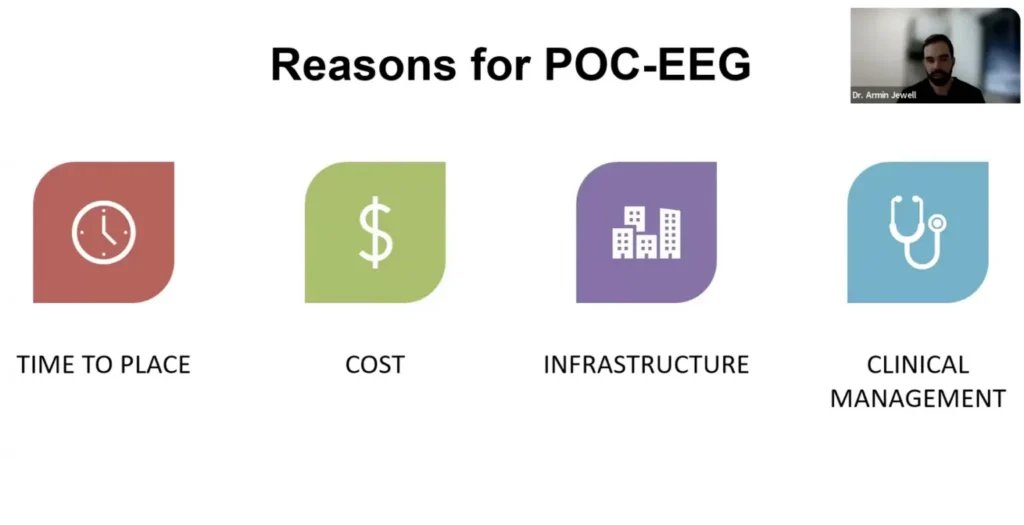
Earlier monitoring may also translate into meaningful clinical and economic benefits. Studies reviewed during the webinar demonstrated reductions in interfacility patient transfers, shorter hospital and ICU stays, and overall cost savings. Dr. Jewell cited a cohort study by Ward et al., which estimated savings of approximately $14,000 per patient annually.
Perhaps most importantly, earlier EEG acquisition can directly influence patient management. As discussed during the webinar, rapid EEG significantly affected treatment decisions in patients with suspected nonconvulsive status epilepticus (NCSE) by helping clinicians start the treatment faster.
When to Use Point-of-Care EEG
Dr. Jewell reviewed several clinical scenarios where point-of-care EEG can provide meaningful value by supporting rapid neurological assessment and earlier clinical decision-making.
Suspected Nonconvulsive Status Epilepticus (NCSE)
One of the primary indications for point-of-care EEG is the rapid evaluation of patients with unexplained altered mental status and suspected NCSE. Dr. Jewell emphasized that POC EEG is particularly valuable for confirming ongoing seizure activity or helping exclude seizures as the cause of neurological deterioration.
Stroke
In patients presenting with acute stroke or stroke-like symptoms, point-of-care EEG can help determine whether seizure activity is contributing to altered mental status or neurological deficits, complementing – but not replacing – neuroimaging.
Traumatic Brain Injury (TBI)
Dr. Jewell reviewed emerging evidence supporting the use of point-of-care EEG in patients with traumatic brain injury. Rapid EEG may assist with early neurological assessment, seizure detection, prognostication, and even future prehospital applications.
Post–Cardiac Arrest
Continuous EEG plays an established role following cardiac arrest, and point-of-care EEG may provide valuable early neurological information.
Delirium
Emerging research suggests that EEG may help identify characteristic brain activity associated with ICU delirium. Dr. Jewell reviewed early studies evaluating point-of-care EEG and AI-assisted algorithms as potential tools for more objective delirium assessment.
Limitations of Point-of-Care EEG
Like any diagnostic technology, point-of-care EEG has important limitations that clinicians should understand.
Reduced Electrode Coverage
Many point-of-care EEG systems use a reduced electrode array rather than the full 10–20 International System used in conventional EEG. While this simplified design enables rapid bedside setup, it also captures electrical activity from fewer areas of the brain. As a result, certain seizure types—particularly brief, focal, low-burden, or parasagittal seizures—may not be detected. For this reason, a negative point-of-care EEG should not be interpreted as definitively ruling out seizure activity. When clinical suspicion remains high, conventional continuous EEG is still recommended for a more comprehensive evaluation.
AI Is a Screening Tool
AI-assisted seizure detection is a valuable feature of many point-of-care EEG systems, but it has important limitations. According to Dr. Jewell, current algorithms tend to favor detecting high overall seizure burden rather than isolated or brief seizure events. As a result, AI is best used as a screening tool that helps identify patients who may need urgent attention. Physician review remains essential to confirm the findings and ensure that subtle seizures or other clinically significant EEG abnormalities are not missed.
“AI is a clinical decision-support tool, but physician interpretation remains essential.”
False Positives and False Negatives
Motion artifact, muscle activity, poor electrode contact, and electrical interference can affect EEG recordings and occasionally result in inaccurate AI alerts. Dr. Jewell emphasized that automated findings should always be interpreted within the clinical context.
10 Key Takeaways from Dr. Jewell’s Presentation
- Point-of-care EEG enables rapid detection of NCSE and high seizure burden.
- It is best suited for detecting sustained or generalized seizure activity.
- A negative point-of-care EEG does not rule out seizures.
- It should be viewed as a triage tool and used to guide escalation to continuous EEG when appropriate.
- AI-assisted seizure alerts are helpful but do not replace clinical interpretation.
- Point-of-care EEG is especially valuable in community and resource-limited hospitals.
- EEG artifacts are common and should always be recognized during interpretation.
- Early EEG findings can meaningfully influence both the escalation and de-escalation of antiseizure therapy.
- Point-of-care EEG can identify important EEG patterns beyond seizures, including burst suppression in selected patients.
- Expert review remains essential when EEG findings are equivocal or clinical suspicion remains high.
Frequently Asked Questions About Point-of-Care EEG
What is point-of-care EEG?
Point-of-care EEG (POC EEG) is a rapid bedside brain monitoring technology developed to address the logistical, technical, and workflow limitations of conventional EEG in patients with acute neurological conditions. Designed for quick deployment, POC EEG enables clinicians to obtain clinically relevant EEG information within minutes, supporting earlier diagnosis and treatment decisions when time is critical. First POC EEG devices received FDA clearance in ~2018.
How is point-of-care EEG different from conventional EEG?
Point-of-care EEG is designed to prioritize speed, simplicity, and accessibility. Compared with conventional EEG, it offers several practical advantages:
- Rapid setup at the bedside
- Simple application
- No dedicated EEG technologist required for electrode placement / setup
- Typically uses a reduced electrode montage (although Zeto system offers full-head coverage)
- Disposable electrode systems for streamlined workflow
When should point-of-care EEG be used?
Dr. Jewell emphasized that point-of-care EEG is most valuable when rapid neurological assessment is needed. Common clinical scenarios include patients with unexplained altered mental status, suspected nonconvulsive status epilepticus (NCSE), stroke, traumatic brain injury, post–cardiac arrest, and cases of ICU delirium. It is particularly useful when conventional EEG is not immediately available or when clinicians need timely information to start treatment.
Does point-of-care EEG require an EEG technologist?
No. One of the defining features of point-of-care EEG is that it does not require a dedicated EEG technologist for electrode placement. After appropriate training, physicians, nurses, or other healthcare providers can apply the device, allowing EEG monitoring to begin much sooner than conventional workflows often permit.
What are the limitations of point-of-care EEG?
Although point-of-care EEG provides valuable clinical information, it has important limitations. Depending on the system, reduced electrode coverage may be a big limiting factor.
Motion artifact, muscle activity, and electrical interference can also affect signal quality. Dr. Jewell emphasized that understanding these limitations is essential for using POC EEG appropriately and determining when conventional EEG is still needed.
Can AI diagnose seizures?
AI tools can assist with seizure detection, but it does not replace physician interpretation. Many point-of-care EEG systems use AI algorithms to identify patients with high seizure burden and generate alerts for bedside clinicians. While these tools can improve workflow and prioritize urgent cases, Dr. Jewell stressed that AI outputs must always be interpreted within the broader clinical context. Final diagnosis and treatment decisions remain the responsibility of experienced clinicians.
Is point-of-care EEG useful after cardiac arrest?
Yes. Dr. Jewell included stroke among the clinical applications of point-of-care EEG and presented a case of a patient with prior stroke who developed sudden unresponsiveness. In these situations, rapid EEG can help determine whether ongoing seizure activity is contributing to the patient’s neurological condition and support early treatment decisions
Is point-of-care EEG useful in stroke patients?
Yes. Point-of-care EEG can complement the evaluation of patients with suspected stroke by helping clinicians identify seizures that may mimic or accompany acute cerebrovascular events. Although EEG does not replace neuroimaging, it can provide additional physiologic information in patients with altered mental status, fluctuating neurological deficits, or concern for nonconvulsive seizures during stroke evaluation.
Can point-of-care EEG reduce hospital transfers?
According to studies reviewed during the webinar, point-of-care EEG may reduce unnecessary transfers, particularly in community and resource-limited hospitals. Earlier access to EEG can support local decision-making, reduce delays in diagnosis, lower costs, and decrease hospital and ICU length of stay.
What is the future of point-of-care EEG?
According to Dr. Jewell, the future of point-of-care EEG extends beyond rapid seizure detection. Advances in artificial intelligence, quantitative EEG, wearable full-head systems, and remote interpretation are expected to further improve access to neurological monitoring. Ongoing research is also exploring new applications in prehospital care, traumatic brain injury, delirium, and neuroprognostication. As the technology continues to evolve, point-of-care EEG is likely to become an increasingly important component of emergency and critical care workflows – always as a complement to, rather than a replacement for, conventional EEG.