



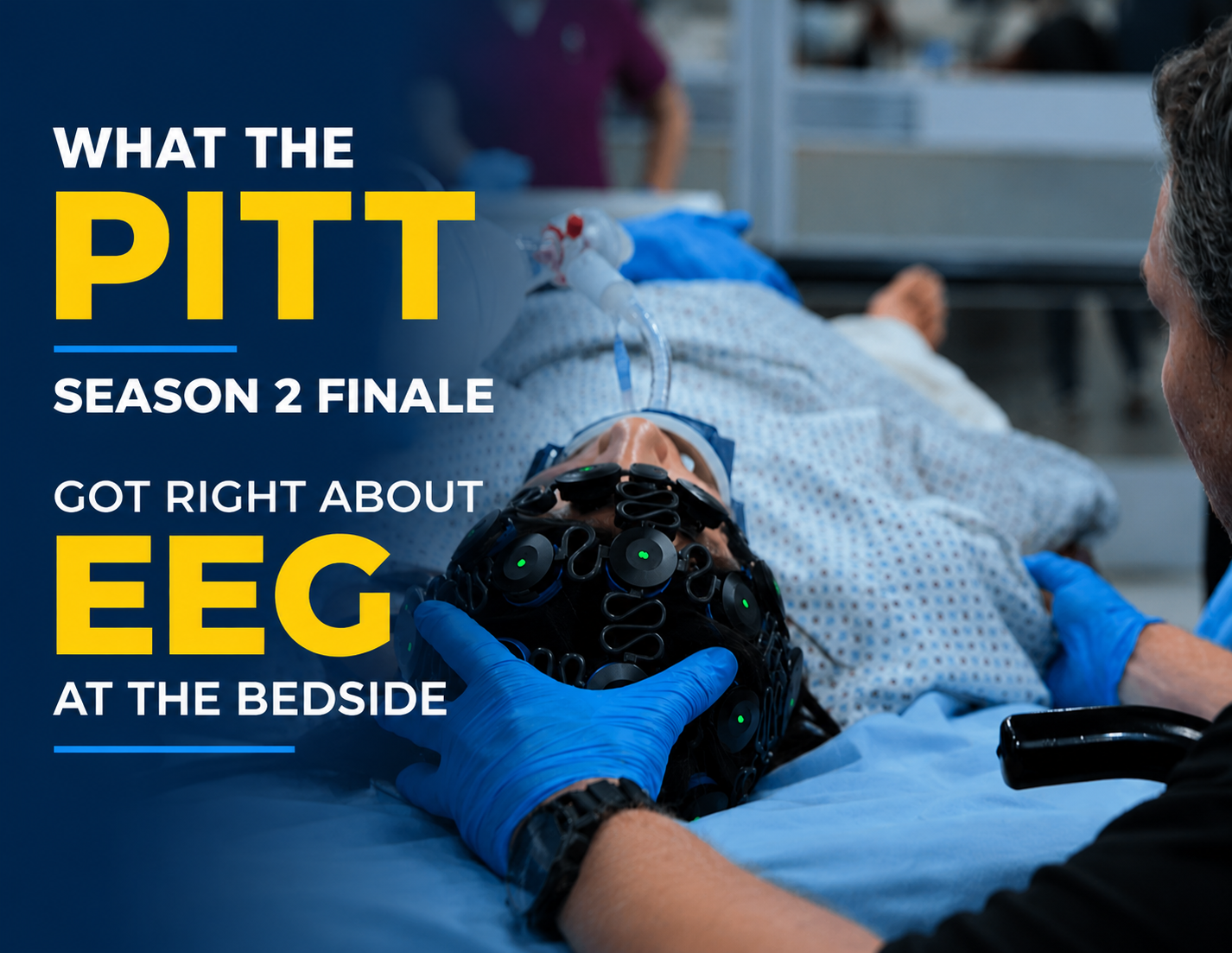
Screenshot from Season 2, Episode 15 of The Pitt (HBO Max).
Medical dramas often capture urgency well – but not always the realities of clinical workflow, especially when it comes to diagnostics like EEG.
The Season 2 finale of The Pitt stands out for a different reason. In a critical moment, it accurately reflects a common challenge in acute care: making decisions when neurologic status is uncertain and access to EEG isn’t immediate.
A Familiar Scenario
In the episode, a pregnant patient presents with signs of severe preeclampsia and rapidly deteriorates. She develops seizures, requiring immediate stabilization and escalation of care.
Amid this, a key clinical question emerges:
Is there ongoing seizure activity?
Seizures may or may not be visible – and are not always continuous. In critically ill patients, clinical presentation can evolve quickly, and without EEG, it can be difficult to determine whether seizure activity is present, ongoing or has resolved.
Where the Episode Gets It Right
Rather than relying on assumption, the team initiates EEG at the bedside using Zeto ONE, with support from NeuroPulseTM – an AI seizure detection tool that helps identify seizure activity in real time and calculate seizure burden, or the total duration of seizure activity over time.
In high-acuity or continuously monitored patients, this type of support can help surface relevant events more efficiently and reduce reliance on constant manual review, while keeping interpretation within the clinical team.
Within moments, they have an answer.
“That was fast.”
The whole scene is just a few minutes, but it reflects something meaningful: access to neurologic data in real time, during active decision-making – not after the fact.
Why That Matters in Practice

Seizures are not always obvious, and in critically ill patients, clinical presentation can evolve quickly or there may be no clinical signs at all. Without EEG, it can be difficult to determine whether there is ongoing seizure activity and the need for intervention.
Seizures in critically ill patients are more common – and more hidden – than many realize.
Across ICU populations, seizures occur in ~3%–34% of patients (Varelas et al., 2013, Seizures and the Neurosurgical Intensive Care Unit), with 10%–20% detected only on EEG (Hirsch & Gopaul, 2026, EEG in the Critical Care Setting)
In comatose patients, the risk is even higher, with up to one-third experiencing electrographic seizures and ~8%–20% in nonconvulsive status epilepticus, often without visible signs (Claassen et al., Neurology, 2004; Neurocritical Care Society Guidelines).
The takeaway is clear: without rapid access to EEG, critical neurologic events can be missed. As seen in The Pitt, solutions like Zeto help bring EEG to the bedside faster – when every minute matters.
In many settings, access to EEG depends on staffing, equipment availability, or workflow constraints. As a result, decisions are sometimes made without real-time confirmation.
That’s the gap this scene highlights.
What Changes with Timely EEG
Timely EEG doesn’t simplify complex cases – but it helps clarify them. By providing objective insight into current brain activity, it allows clinicians to confirm or rule out ongoing seizure activity in real time.
When seizures are ongoing, that information can support earlier initiation or escalation of anti-seizure treatment. When they are not, it can help avoid unnecessary intervention and shift focus to the underlying cause.
In high-acuity settings, that clarity can influence both prioritization and next steps.
Reflecting a Broader Shift
While dramatized, the workflow shown in The Pitt aligns with a broader trend: bringing diagnostics closer to the bedside.
Point-of-care EEG systems, including Zeto ONE, are part of that shift – aimed at reducing delays between clinical questions and neurologic data.
Why the Scene Feels Real
A recent feature from The Wall Street Journal highlights the show’s emphasis on realism, from detailed set design to ongoing medical consultation.
It also notes the inclusion of real-world medical technologies:
“The Pitt often features the latest real-world medical technology, such as this cap that quickly measures electrical activity in the brain (EEG).”


Final Thought
What The Pitt gets right is not just the clinical intensity, but the uncertainty that comes with it – and the importance of resolving that uncertainty quickly.
In practice, access to timely information often shapes decisions and improves outcomes.
Where to watch:
The full TV show and episode 15 is available on HBO Max: LINK
Watch the trailer here: LINK